How bacteria keep transcribing long biosynthetic operons
Bacteria make polyketide antibiotics and other specialized metabolites from gene clusters that can run for tens of kilobases. Transcribing a cluster that long is expensive, and RNA polymerase meets terminators along the way, so the cell needs a way to decide when to read through them. I study the proteins that make that decision, and what happens when they act on the wrong genes.
LoaP, a specialized NusG paralog
NusG is a universally conserved transcription elongation factor. Many bacteria also encode specialized paralogs that act on a narrow set of genes. In Bacillus velezensis FZB42, the paralog LoaP binds an RNA hairpin in the leader region of the macrolactin (mln) and difficidin (dfn) polyketide synthase operons and promotes transcriptional antitermination, allowing elongation across the whole cluster.
LoaP homologs occur across Bacillus, Paenibacillus, Brevibacillus and other groups, usually next to long biosynthetic operons, but whether they regulate those pathways has not been established. My work asks how general the mechanism is, and whether LoaP can be used as a tool to switch on biosynthetic clusters that are otherwise silent.
Antitermination by homologs from non-model species
I tested LoaP homologs from Bacillus inaquosorum, B. cereus, B. thuringiensis ser. pondicherriensis and Paenibacillus polymyxa in a heterologous Bacillus subtilis reporter, built from the B. velezensis dfn leader fused to yfp.
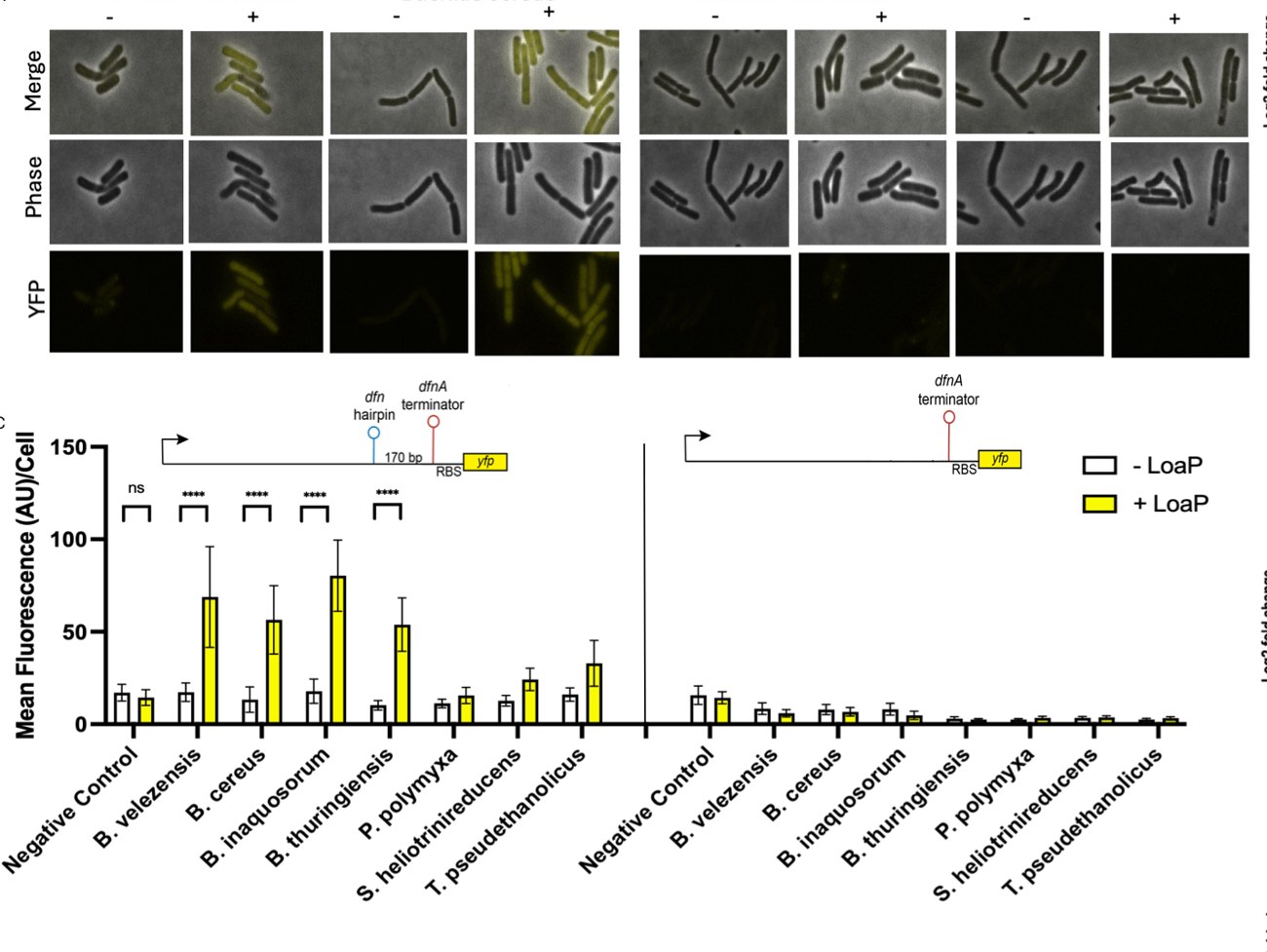
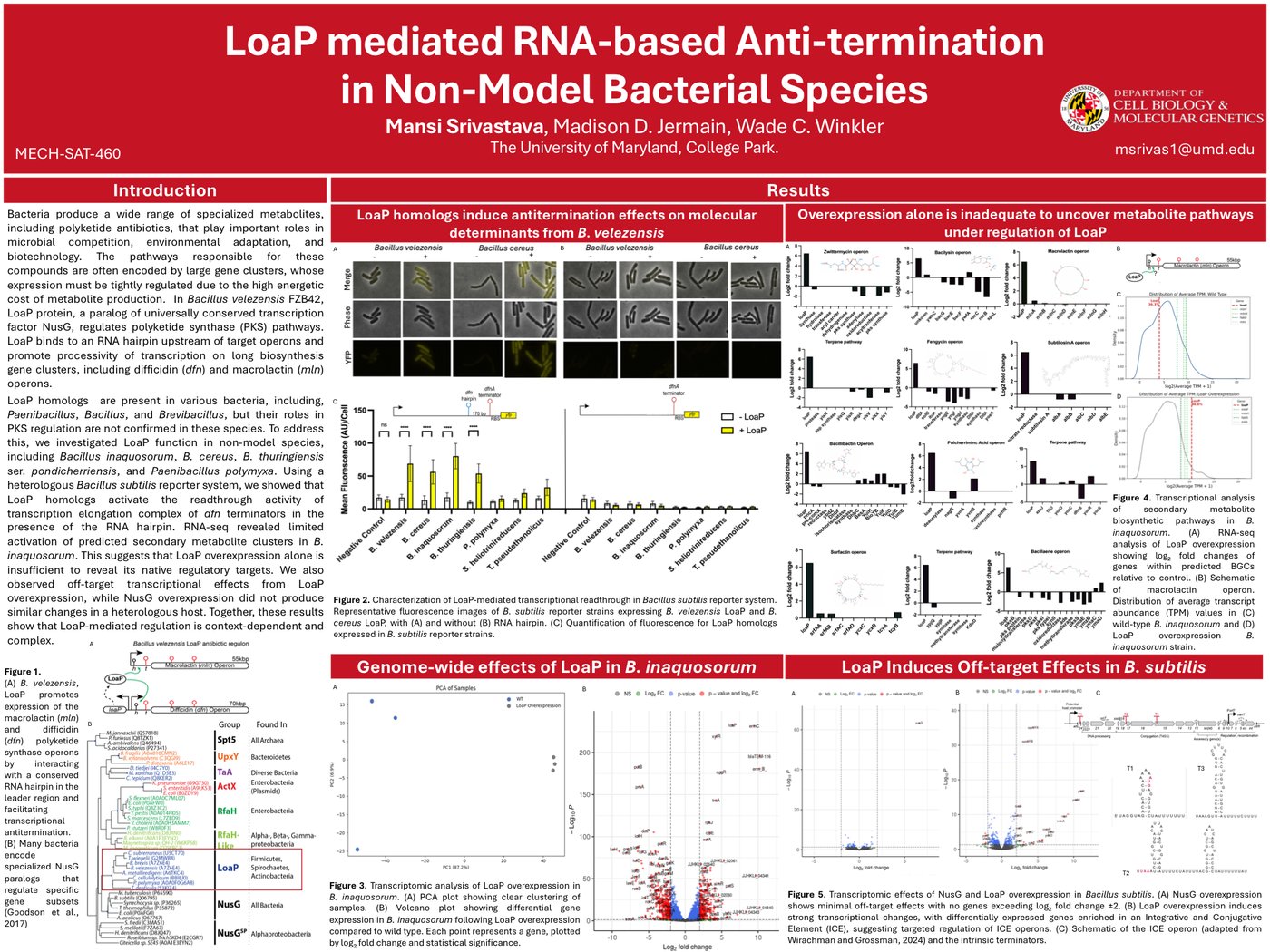
Diverse homologs promoted readthrough of the dfn terminator, and only when the leader RNA hairpin was intact. Removing the hairpin abolished the effect. The homologs therefore act on the same molecular determinants as B. velezensis LoaP, which supports a conserved, RNA-dependent antitermination mechanism.
What LoaP does to the rest of the genome
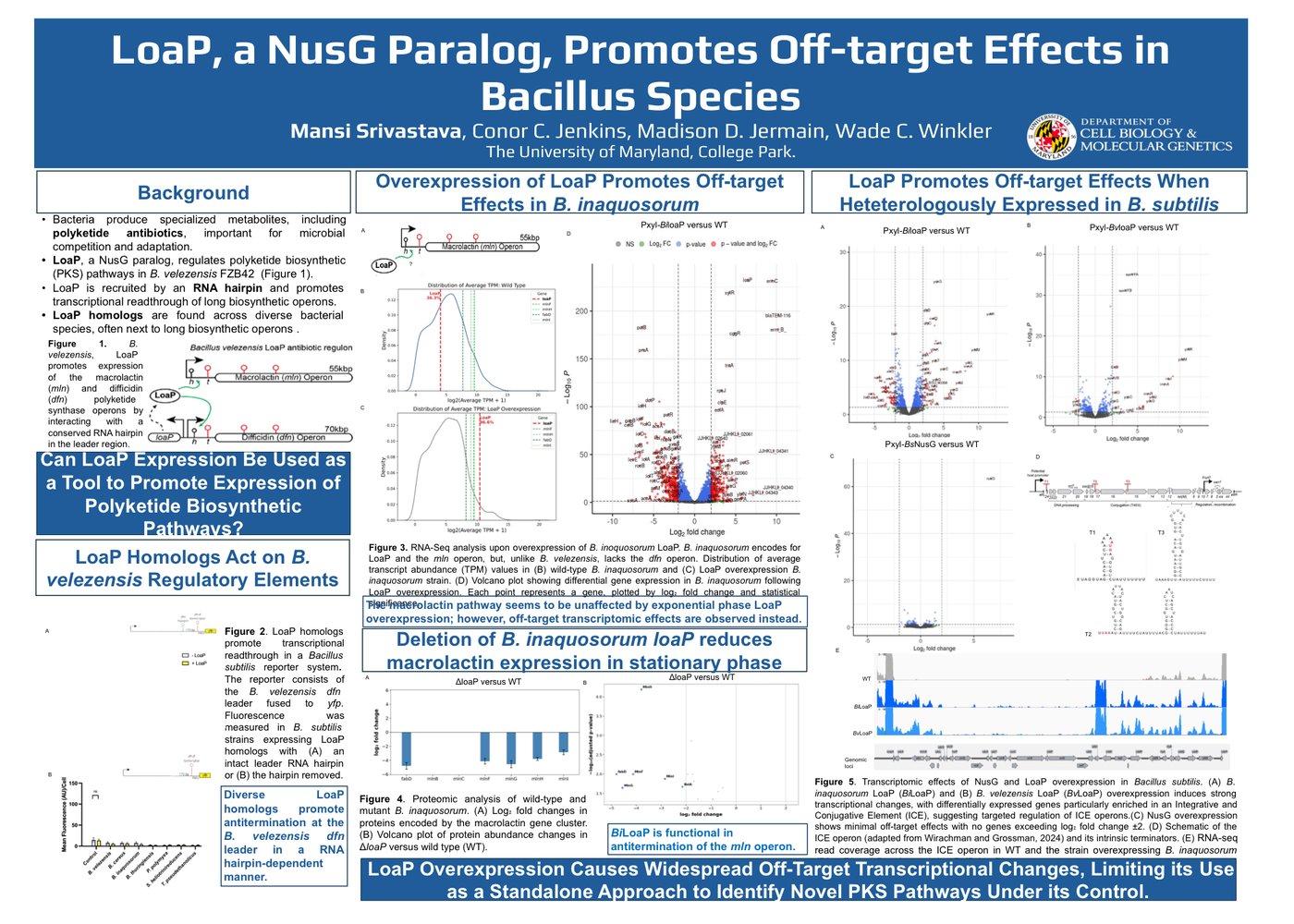
Overexpressing LoaP in its native host, B. inaquosorum, did not noticeably activate the macrolactin pathway during exponential growth, so overexpression alone is not enough to reveal a homolog's native targets. Deleting loaP, on the other hand, reduced macrolactin protein levels in stationary phase, which supports LoaP-mediated regulation of that cluster.
RNA-seq also showed widespread off-target transcriptional changes when LoaP homologs were expressed in B. subtilis, with differentially expressed genes concentrated in an integrative and conjugative element, in a pattern consistent with antitermination inside the ICE operon. NusG overexpression produced no comparable changes under the same conditions. LoaP-mediated regulation is therefore context-dependent, and LoaP expression on its own is not a reliable way to discover new polyketide pathways.
With Conor C. Jenkins, Madison D. Jermain and Wade C. Winkler, University of Maryland, College Park.
Earlier work
Latent structure in sequence data
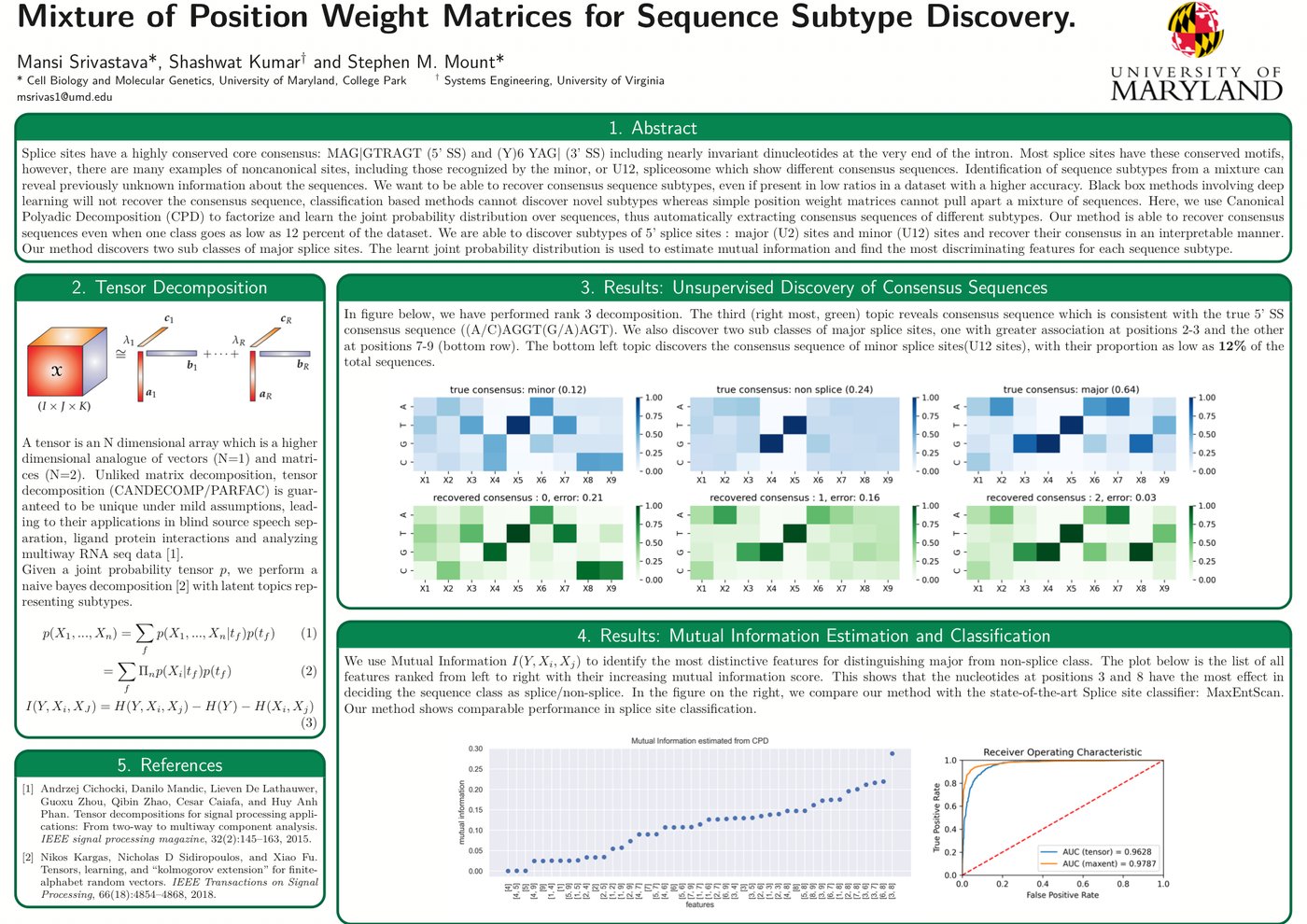
Splice sites share a strong core consensus, but a single position weight matrix cannot separate a mixture of subtypes, classifiers cannot discover subtypes they were never told about, and deep models do not return a consensus sequence at all. With Stephen M. Mount at Maryland, I used canonical polyadic decomposition to factorize the joint probability distribution over sequence positions, which recovers each subtype's consensus directly as a latent factor.
A rank-3 decomposition of 5′ splice sites recovered the major (U2) consensus, two subclasses of major sites that differ in which positions are coupled, and the minor (U12) consensus even when minor sites were only 12% of the data. The same fitted distribution gives mutual information estimates, which rank positions 3 and 8 as the most discriminating, and classification performance comparable to MaxEntScan.
2021–2023, with Shashwat Kumar and Stephen M. Mount. Presented at the NCI RNA Biology Symposium, April 2023.
Yeast surviving repeated freeze–thaw
At the National Centre for Biological Sciences, with Shashi Thutupalli, I analyzed single-nucleotide polymorphisms and copy-number variation in yeast populations that had been through repeated freeze–thaw cycles, looking for the genomic regions behind their increased survival and trehalose production.
2018–2019.
Cell-based biosensors and protein purification
At IBAB, I built cell-based biosensors that detect heavy metals by exploiting the cell's own machinery for handling essential metals, and expressed and purified ArsM in E. coli at scale.
2018.